Format & free template
Quotation format
A quotation is a priced offer you send before a sale: these items, at these rates, on these terms, valid until a date. It is not a bill and carries no tax liability.

Where a quotation fits
A buyer asks for rates. You send a quotation. If they agree, they send a purchase order or confirm on call, you raise a sales order or proforma invoice, and when the goods go out you issue the tax invoice. The quotation is the first paper in that chain, and the rate on it is what the buyer will hold you to.
Contractors, distributors quoting a new dealer, electrical and hardware suppliers bidding for a project, and service firms all use them daily. A quick, clear quotation often decides who gets the order.
Sample quotation format
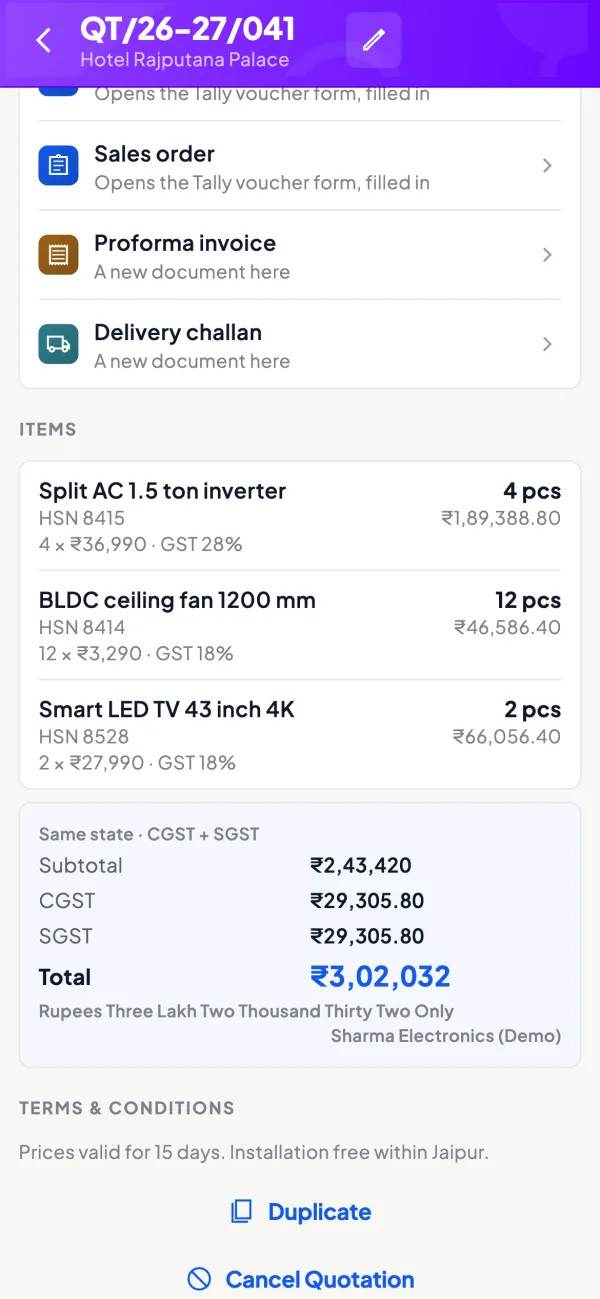
The sample uses made-up details. Switch between the Classic, Modern and Compact layouts, Print / PDF it on A4, or print a Blank template to fill by hand. Open in editor loads it into the free quotation maker, where you type straight onto the page and GST, totals and the amount in words are worked out for you.
Loading the sample…
What to put on it
- Business name, address, GSTIN and contact
- Quotation number and date
- Customer name, contact person and state
- Enquiry or project reference
- Item description, brand/model and HSN
- Quantity, unit, rate and discount
- GST rate and amount
- Freight, packing and installation charges
- Grand total
- Validity period
- Delivery period
- Payment terms
- Signature and name of the person quoting
What a good quotation contains
No law sets a quotation format, so the fields below are good practice:
- Your letterhead with GSTIN, and a quotation number and date.
- The buyer's name, contact person and, if known, GSTIN and state.
- A reference: their enquiry date, tender number or site name.
- Item lines with description, make or brand, HSN, quantity, unit, rate and discount.
- GST shown separately per line or per rate, so the buyer sees the landed cost.
- Validity: "Rates valid for 15 days" protects you from price changes.
- Delivery period, freight (included or extra), installation, warranty.
- Payment terms: advance, credit days, mode of payment.
Worked example
A Ludhiana hardware supplier quotes a builder in Chandigarh for 200 bags of tile adhesive at ₹420 and 50 litres of waterproofing at ₹310.
| Item | Qty | Rate | Amount |
|---|---|---|---|
| Tile adhesive 20 kg | 200 bags | ₹420 | ₹84,000 |
| Waterproofing compound | 50 L | ₹310 | ₹15,500 |
| Taxable value | ₹99,500 | ||
| IGST 18% | ₹17,910 | ||
| Total | ₹1,17,410 |
Chandigarh is a union territory, separate from Punjab, so the supply is inter-state and the quotation shows IGST. Getting this right at the quotation stage avoids a surprised buyer later. Check the tax rate for each item before quoting; rates are notified and can change.
Tips that win orders
- Send it the same day, as a PDF, on the channel the buyer used to ask.
- Quote the exact model or grade asked for, and offer one alternative separately rather than mixing them.
- Round the grand total only at the end, not each line.
- Number your quotations (QT/26-27/052) so you can follow up: "about our quotation 52 of 3 October".
- Revise as R1, R2 rather than issuing a fresh number, so the history is clear.
For more ideas, see quotation best practices.
Following up on a quotation
Most quotations that are lost are simply never chased. Keep a short list of open quotations with the date sent, value and next follow-up date. Call or message on day three to ask whether anything needs changing, and again just before the validity ends. When a quotation is lost, note the reason, such as price, delivery time or brand. After a few months the notes show where you lose orders, which is more useful than any single sale.
Quotation, estimate or proforma?
A quotation is a firm offer at stated rates. An estimate is an approximate cost, common in repair and contract work, where the final bill can differ. A proforma invoice looks like an invoice and is often sent once the order is agreed, to collect an advance. None of the three is a tax invoice, and none is entered in GST returns.
In TallyPrime, a quotation is not an accounting entry. Once accepted it usually becomes a Sales Order voucher, which later converts into the sales invoice.
Make one now with the free quotation maker
Questions people ask
Is a quotation legally binding?
A quotation is an offer. It becomes a contract when the buyer accepts it within the validity period, usually with a purchase order. State the validity and key terms to avoid disputes.
Should GST be shown in a quotation?
Yes, show the GST rate and amount separately so the buyer knows the full cost. No tax is payable on a quotation itself.
How long should a quotation be valid?
Commonly 7 to 30 days, shorter where prices move quickly, such as metals or electronics.
Can I convert a quotation into an invoice?
Yes. Once the buyer agrees, the same lines go into a sales order or straight into the tax invoice. Software that converts it saves retyping and rate mistakes.
Do I need a separate number series for quotations?
It is good practice. Keep it separate from your invoice series so tax invoice numbers stay consecutive.
This page is general information for Indian businesses, not tax or legal advice. GST rules, limits and formats change by notification — check cbic-gst.gov.in or gst.gov.in, or ask your CA.