
GST GST basics
GST state codes list
Every state and union territory has a two-digit GST state code. It is the first two digits of every GSTIN and is used for place of supply on invoices, e-way bills and returns.
- GST-registered traders
- Billing and accounts staff
- Businesses selling across states
- E-way bill and e-invoice users
- Accountants filing GSTR-1

On this page 10
Full list of GST state codes
| Code | State or union territory | Type |
|---|---|---|
| 01 | Jammu and Kashmir | Union territory |
| 02 | Himachal Pradesh | State |
| 03 | Punjab | State |
| 04 | Chandigarh | Union territory |
| 05 | Uttarakhand | State |
| 06 | Haryana | State |
| 07 | Delhi | Union territory |
| 08 | Rajasthan | State |
| 09 | Uttar Pradesh | State |
| 10 | Bihar | State |
| 11 | Sikkim | State |
| 12 | Arunachal Pradesh | State |
| 13 | Nagaland | State |
| 14 | Manipur | State |
| 15 | Mizoram | State |
| 16 | Tripura | State |
| 17 | Meghalaya | State |
| 18 | Assam | State |
| 19 | West Bengal | State |
| 20 | Jharkhand | State |
| 21 | Odisha | State |
| 22 | Chhattisgarh | State |
| 23 | Madhya Pradesh | State |
| 24 | Gujarat | State |
| 26 | Dadra and Nagar Haveli and Daman and Diu | Union territory |
| 27 | Maharashtra | State |
| 29 | Karnataka | State |
| 30 | Goa | State |
| 31 | Lakshadweep | Union territory |
| 32 | Kerala | State |
| 33 | Tamil Nadu | State |
| 34 | Puducherry | Union territory |
| 35 | Andaman and Nicobar Islands | Union territory |
| 36 | Telangana | State |
| 37 | Andhra Pradesh | State |
| 38 | Ladakh | Union territory |
| 97 | Other Territory | Areas outside any state or UT, such as offshore installations |
Codes follow the census numbering of states. Two numbers are no longer in use: 25 was the old code for Daman and Diu, which merged with Dadra and Nagar Haveli in 2020 under code 26, and 28 was the code for Andhra Pradesh before the state was divided; the current code for Andhra Pradesh is 37, and Telangana has 36. Ladakh received 38 after it became a separate union territory. If you meet an old document with code 25 or 28, check the party's current GSTIN on the portal.
Where the code appears
- GSTIN: the first two characters. A GSTIN beginning 27 is registered in Maharashtra, 08 in Rajasthan. See how to read a GSTIN.
- Tax invoice: the place of supply, written as state name and code, for example "Place of supply: 29-Karnataka".
- GSTR-1: every B2C line and every B2B invoice carries the place of supply code.
- E-way bill and e-invoice: dispatch and delivery states are selected by code.
- GSTR-3B Table 3.2: inter-state supplies to unregistered buyers are reported state-wise.
Using the code to decide the tax
Compare the first two digits of your own GSTIN with the place of supply code:
- Same code, for example your GSTIN starts 24 and goods go to 24-Gujarat: CGST + SGST.
- Different code, for example 24 to 27-Maharashtra: IGST.
Example. A Surat seller (24) ships ₹1,00,000 of goods to Vapi (also 24) and ₹1,00,000 to Silvassa (26, Dadra and Nagar Haveli and Daman and Diu). At 18%, the Vapi invoice carries CGST ₹9,000 + SGST ₹9,000; the Silvassa invoice carries IGST ₹18,000, even though Silvassa is only a short drive away. In the reverse direction, a seller registered in that union territory would charge CGST + UTGST on local sales.
Note that the place of supply, not the buyer's GSTIN, is compared. In bill-to-ship-to and some other cases they differ; see place of supply for goods.
Exports, SEZ and other special cases
- Exports. The place of supply is outside India, so no Indian state code applies to the buyer. On invoices and in returns, exports are reported in their own table with port and shipping bill details, not by state.
- SEZ units. An SEZ unit has a GSTIN with the code of the state where the zone is located, but supplies to it are treated as inter-state anyway. The state code alone will mislead you here.
- Branches in several states. Each branch has its own GSTIN with its own code. Make sure the invoice is raised from the GSTIN of the branch actually supplying.
- Unregistered customers. There is no GSTIN to read the code from, so record the delivery state on the invoice and in the party master.
Common mistakes with state codes
- Selecting the buyer's billing state when goods are delivered elsewhere on the buyer's own instruction from another GSTIN.
- Using 28 for Andhra Pradesh in a new party master.
- Treating Dadra and Nagar Haveli and Daman and Diu as part of Gujarat or Maharashtra.
- Leaving the state blank for unregistered parties, so B2C sales cannot be summarised state-wise.
This is general information, not tax advice.
State codes in Tally and Cashflow OS
In TallyPrime each party ledger has a state, and Cashflow OS uses that state when it works out GST on a voucher created from the phone: a party in another state gets IGST, a local party CGST and SGST. In the GSTR-1 view, B2C lines are grouped by place of supply, so a wrong state on a customer shows up there. The GSTIN glossary entry explains the rest of the number.
Avoid these
Common mistakes
- MistakeUsing 28 for Andhra Pradesh in a new partyDo this instead
Use 37 for Andhra Pradesh and 36 for Telangana; check the party's current GSTIN on the portal.
- MistakeComparing the buyer's GSTIN instead of place of supplyDo this instead
Decide the tax on the place of supply; in bill-to-ship-to cases it can differ from the buyer's GSTIN state.
- MistakeTreating supplies to an SEZ unit as localDo this instead
Supplies to SEZ units are treated as inter-state even when the zone is in your state.
- MistakeLeaving the state blank for unregistered partiesDo this instead
Record the delivery state on B2C invoices and party masters so sales can be summarised state-wise.
Keep handy
Checklist
GST state codes list — 7 checks. Tick them as you go.
In Cashflow OS
How Cashflow OS helps
Cashflow OS puts your TallyPrime books on every phone in the team. Where it fits this topic:
GST worked out from the party's state
When a voucher is created in Cashflow OS, GST is worked out from the item and the party's state in Tally: IGST for another state, CGST and SGST for a local party.
See Create Tally vouchers from your phone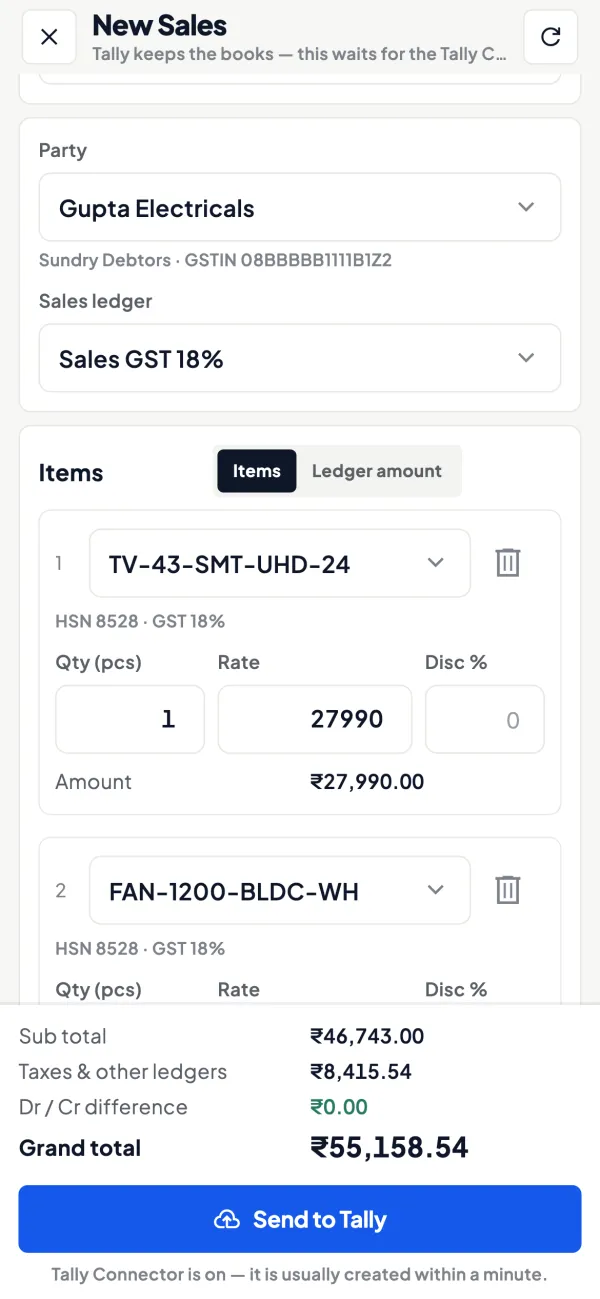
Wrong states show up in GSTR-1
In the GSTR-1 view prepared from your Tally data, B2C lines are grouped by place of supply, so a customer with the wrong state stands out.
See GST reports from your Tally data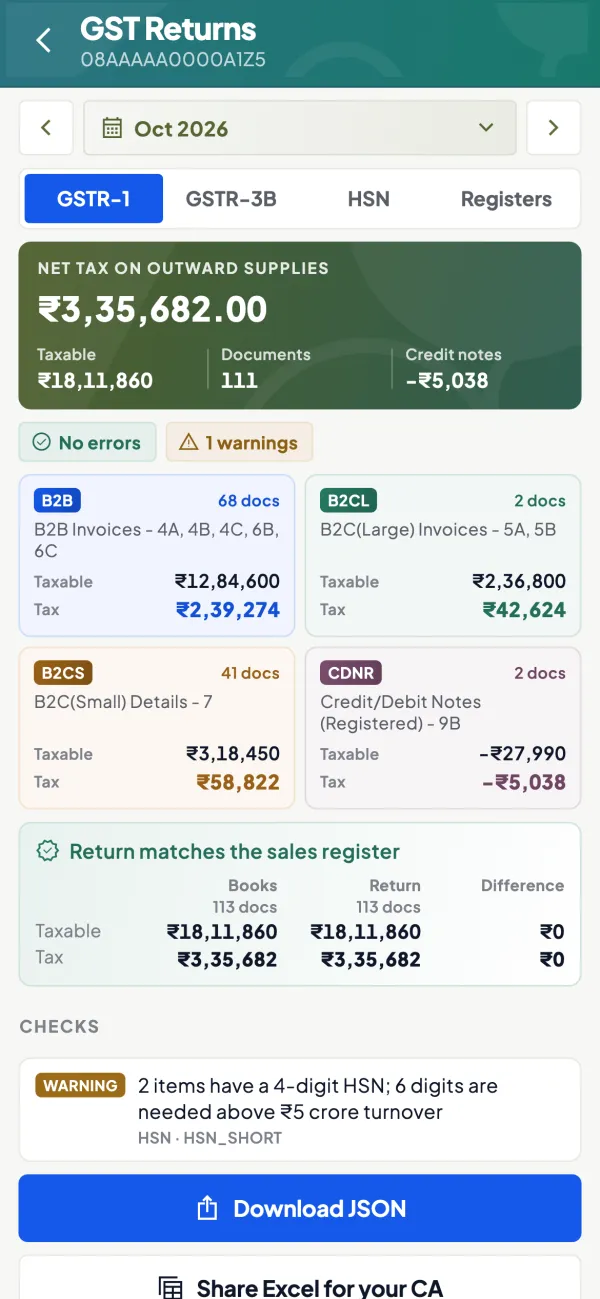
Questions people ask
What is the GST state code for Delhi?
Why is there no state code 28 any more?
What is code 97 used for?
Which code is Dadra and Nagar Haveli and Daman and Diu?
What is the GST state code for Maharashtra?
What is the GST state code for Rajasthan?
How do I find a party's state from its GSTIN?
Which tax applies on a sale within a union territory?
This page is general information for Indian businesses, not tax, legal or financial advice. Rules and rates change — check the official portals or your CA before acting.