GST GST valuation
GST on free samples and gifts
Goods given away free to an unrelated person are usually not a taxable supply, but the input tax credit on them is blocked. Gifts to related persons, branches with another GSTIN, and employees above a yearly limit follow different rules.
- Tile and sanitaryware dealers
- Pharma and FMCG distributors
- Manufacturers giving samples
- Businesses giving Diwali gifts
- Accountants handling ITC reversal
On this page 11
Why 'free' still matters under GST
GST is a tax on supply for consideration. A sample handed to a prospective customer with nothing asked in return is usually not a supply. But Section 17(5)(h) of the CGST Act blocks input tax credit on goods 'disposed of by way of gift or free samples'. So you pay nothing on the way out, and you lose the credit you took on the way in.
In practice this means you must reverse the ITC on goods that leave your stock as samples or gifts, or not claim it at all if you bought them for that purpose.
Who you give to changes the answer
| Recipient | Is it a supply? | ITC |
|---|---|---|
| Unrelated customer or prospect | No (no consideration) | Blocked; reverse it |
| Employee, gifts up to ₹50,000 in a year | Not treated as a supply | Blocked for gifts |
| Employee, gifts above ₹50,000 in a year | Treated as a supply; GST payable on value | Available against that supply |
| Related person or your own branch with another GSTIN | Supply even without consideration (Schedule I) | Available; GST charged |
The ₹50,000 employee gift limit can be changed by notification, so confirm it on cbic-gst.gov.in. Items an employer must provide under the employment contract, such as uniforms, are treated differently from gifts.
Worked example: reversing ITC on samples
A tiles dealer buys 500 boxes at ₹400 each plus 18% GST and claims ITC of ₹36,000. During the month, 20 boxes go to architects as display samples, free of cost.
- Cost of samples: 20 × ₹400 = ₹8,000
- ITC attributable: ₹8,000 × 18% = ₹1,440
- Reverse ₹1,440 in GSTR-3B (ITC reversed section) for that month.
No outward GST is charged to the architects. Book the ₹8,000 as sales promotion expense and the ₹1,440 as part of that expense, not as a recoverable tax.
Samples that are not really free
Watch for arrangements that look free but are not:
- Free goods tied to a purchase ('buy 10 cartons, get 1 free') are part of a priced deal. The customer pays for the lot, so there is no free supply and no ITC reversal. See GST on discounts and schemes.
- Demo units sent on approval and returned later are not gifts. Move them on a delivery challan, not an invoice.
- Samples to your own branch in another state are a supply between distinct persons and need a tax invoice; see stock transfers between branches.
Diwali gifts, dealer meets and promotional items
Festival gifts to dealers, sweets boxes for customers, or wall clocks with your logo are generally gifts, and ITC on them is blocked. Some businesses take the credit at purchase and forget to reverse it later. It is cleaner to book such purchases straight to a gift or promotion ledger without ITC.
Prizes handed out at a dealer meet for achieving targets can be different: the dealer earned them by meeting a sales condition, so they may be part of the scheme rather than a free gift. Document the scheme before it starts. This is general information, not tax advice.
Recording samples in your books
- Create a ledger such as 'Samples and Free Distribution' under indirect expenses.
- Move the stock out with a stock journal or a delivery note to that ledger, so inventory reduces.
- Pass a journal for the ITC reversal so the credit ledger shows the correct balance.
- Keep a register: date, item, quantity, recipient, purpose. It answers most questions in an audit.
Doing this with Tally and Cashflow OS
The sample entries live in TallyPrime. Cashflow OS shows the result on your phone: the expense ledger, item summaries that reveal stock going out as samples, and the GSTR-3B view prepared from your Tally data, where you can check that the reversal made it into the month. If writing back is switched on, staff can post a stock journal from the phone when samples leave the showroom, and Tally validates it. Whether a given gift needs ITC reversal is a judgement for you or your CA.
Avoid these
Common mistakes
- MistakeClaiming ITC on gift purchases and never reversing itDo this instead
Book gift and promotion purchases straight to a gift ledger without ITC, or reverse the credit in GSTR-3B when goods go out.
- MistakeTreating 'buy 10 get 1 free' as a free sampleDo this instead
The customer pays for the lot, so it is part of the sale. Keep the ITC and charge GST on the price paid.
- MistakeSending samples to another-state branch on a challanDo this instead
A branch with another GSTIN is a distinct person; raise a tax invoice for samples sent there.
- MistakeNo record of samples handed outDo this instead
Keep a register with date, item, quantity, recipient and purpose, and move the stock out in the books.
Keep handy
Checklist
GST on free samples and gifts — 8 checks. Tick them as you go.
In Cashflow OS
How Cashflow OS helps
Cashflow OS puts your TallyPrime books on every phone in the team. Where it fits this topic:
See stock going out as samples
Item summaries synced from Tally show stock movement, and the expense ledger shows what was booked as samples, so you can check the month's entries on the phone.
See Tally on mobile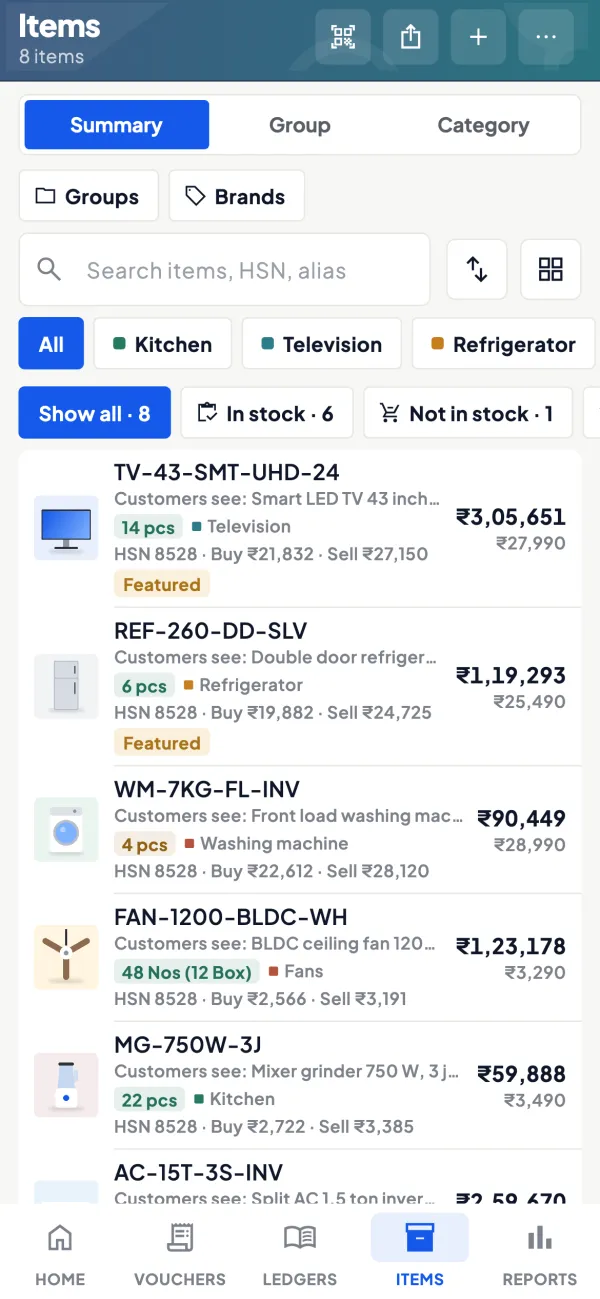
Post a stock journal from the showroom
With writing back on, staff can post a stock journal from the phone when samples leave; Tally validates it. The GSTR-3B view helps check that the reversal is in the month.
See Create Tally vouchers from your phone
Questions people ask
Do I pay GST on free samples given to customers?
Are employee gifts taxable under GST?
Is 'buy 10 get 1 free' a free sample?
Can I avoid reversal by not claiming ITC on gift items?
Do I reverse ITC on display samples kept in my own showroom?
Are uniforms given to employees gifts?
Is a Diwali gift box to dealers a supply?
How do I show the ITC reversal in my books?
This page is general information for Indian businesses, not tax, legal or financial advice. Rules and rates change — check the official portals or your CA before acting.