GST GST payments
GST electronic ledgers: cash, credit and liability
Every GST registration has three running accounts on the portal: the electronic cash ledger (money you deposit), the electronic credit ledger (input tax credit) and the electronic liability register (what you owe). GSTR-3B settles the liability using the other two.
- Accountants filing GSTR-3B
- GST-registered businesses
- Owners paying GST in cash
- CAs reviewing ITC
- Sellers with inter-state and local sales

On this page 12
The three ledgers at a glance
| Ledger | Money in | Can pay |
|---|---|---|
| Electronic cash ledger | Challan deposits, GST TDS and TCS credits accepted, refunds re-credited | Tax, interest, late fee, penalty and other amounts |
| Electronic credit ledger | ITC claimed in GSTR-3B | Output tax only (not RCM tax, interest or fees) |
| Electronic liability register | Liabilities from returns, interest, demands | Shows what is outstanding |
Each ledger is kept separately for IGST, CGST, SGST/UTGST and cess, with minor heads for tax, interest, penalty, fee and others in the cash ledger.
The order of using ITC
Credit in one head cannot be used freely against another. The rules under Section 49 and Rule 88A work like this:
- IGST credit is used first against IGST liability, then against CGST and SGST in any order or proportion.
- All IGST credit must be used before CGST or SGST credit is used.
- CGST credit pays CGST, then IGST. It can never pay SGST.
- SGST credit pays SGST, then IGST. It can never pay CGST.
The portal applies these rules when you offset liability in GSTR-3B, but understanding them explains why you sometimes pay cash in one head while credit sits in another.
Worked example
A trader's month: liability IGST ₹40,000, CGST ₹30,000, SGST ₹30,000. ITC: IGST ₹60,000, CGST ₹10,000, SGST ₹10,000.
- IGST credit ₹60,000: ₹40,000 pays IGST; the remaining ₹20,000 is split, say ₹10,000 to CGST and ₹10,000 to SGST.
- CGST credit ₹10,000 pays CGST. CGST still due: ₹30,000 − ₹10,000 − ₹10,000 = ₹10,000.
- SGST credit ₹10,000 pays SGST. SGST still due: ₹10,000.
- Cash needed: ₹10,000 CGST + ₹10,000 SGST.
Had the ₹20,000 balance of IGST been used wholly against CGST, you would have paid ₹20,000 SGST in cash instead, and carried ₹10,000 CGST credit forward. The split matters.
Things the cash ledger is for
- Tax under reverse charge, which must be paid in cash; see reverse charge mechanism.
- Interest and late fees; see GST interest and late fees.
- Any tax not covered by credit.
Money deposited in the wrong head can be moved within the cash ledger using Form PMT-09, for example from CGST to IGST. Excess balance can be claimed as a refund.
The ITC reversal and re-claimed statement
The portal also keeps a statement of ITC that you reverse and later reclaim, such as ITC reversed because a supplier was not paid within 180 days and reclaimed once you pay. The reclaimed amount must not be more than what was reversed, as recorded in this statement. Keep it in step with your books; see ITC reversal and the 180-day rule.
Checking the ledgers each month
- Before filing GSTR-3B, view the cash and credit ledger balances on the portal.
- Match the credit ledger closing balance with the GST input ledgers in your books.
- Look for cash sitting in a head where you have no liability; move it with PMT-09 if needed.
- After filing, confirm the liability register shows nothing outstanding for the period.
This is general information, not tax advice.
Common mistakes
- Leaving the IGST credit split to chance in GSTR-3B and then paying cash in SGST while CGST credit piles up, or the reverse.
- Assuming a positive cash ledger balance means the month is paid. Until the return is filed and offset, the liability stays open.
- Treating the GST TDS or TCS received as income in the books instead of a cash ledger balance.
- Claiming a refund of cash ledger balance while the same money is needed for next month's liability.
- Not noticing an old demand or interest entry sitting in the liability register from an earlier period.
A quick look at all three ledgers once a month, five minutes before filing, prevents most of these.
Matching your books with Cashflow OS
The portal ledgers are on gst.gov.in; your side of the story is in TallyPrime's GST ledgers. Cashflow OS syncs those ledgers, so on the phone you can see the balances of your input and output GST ledgers, and the GSTR-3B view prepared from your Tally data shows the month's liability and ITC to compare with the portal before offset.
Avoid these
Common mistakes
- MistakeLeaving the IGST credit split to chanceDo this instead
Plan how leftover IGST credit is split between CGST and SGST in GSTR-3B so cash is not paid in one head while credit sits in another.
- MistakeThinking a cash balance means the month is paidDo this instead
The liability stays open until GSTR-3B is filed and offset; check the liability register after filing.
- MistakeBooking GST TDS or TCS received as incomeDo this instead
Treat it as a balance in the electronic cash ledger once accepted, not as income in the books.
- MistakePaying into the wrong head and leaving itDo this instead
Move cash between heads within the cash ledger using PMT-09.
Keep handy
Checklist
GST electronic ledgers: cash, credit and liability — 7 checks. Tick them as you go.
In Cashflow OS
How Cashflow OS helps
Cashflow OS puts your TallyPrime books on every phone in the team. Where it fits this topic:
GST ledger balances from Tally
Cashflow OS syncs your TallyPrime ledgers, so the input and output GST ledger balances are visible on the phone to compare with the portal.
See Tally on mobile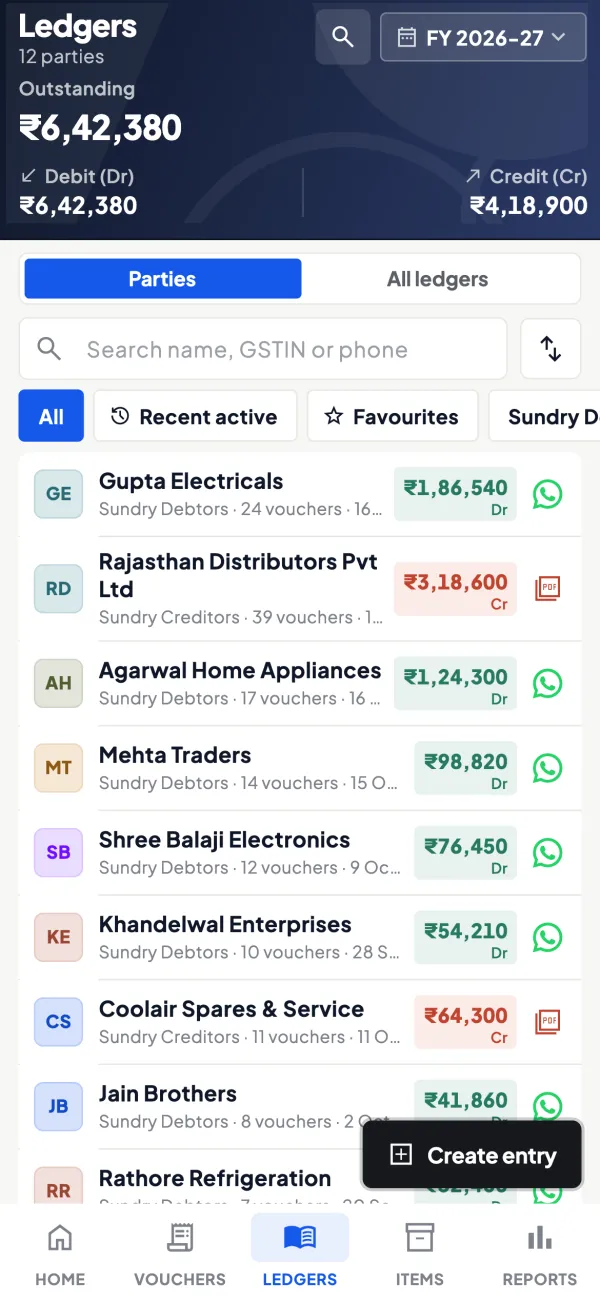
GSTR-3B view before offset
The GSTR-3B view prepared from your Tally data shows the month's liability and ITC to compare with the portal before you offset.
See GST reports from your Tally data
Questions people ask
Can ITC be used to pay GST late fees?
Can CGST credit be used to pay SGST?
What if I paid money under the wrong head?
Why is RCM tax paid in cash when I have credit?
Can I get a refund of excess cash ledger balance?
Where do GST TDS and TCS credits go?
Can IGST credit pay CGST and SGST?
What does the liability register show?
This page is general information for Indian businesses, not tax, legal or financial advice. Rules and rates change — check the official portals or your CA before acting.