GST GST returns
Common GSTR-1 errors and how to avoid them
GSTR-1 errors rarely cost you tax directly, but they cost your buyers credit and lead to calls, mismatches and notices. Most come from a handful of causes, and almost all can be prevented in the billing software.
- GST-registered sellers
- Accountants filing GSTR-1
- Billing staff
- CAs reviewing returns
- Inter-state sellers

On this page 11
The ten errors seen most often
| Error | Effect | Prevention |
|---|---|---|
| Wrong buyer GSTIN | Buyer gets no ITC; someone else does | Verify GSTIN when creating the party |
| B2B sale reported as B2C | Buyer gets no ITC | Mandatory GSTIN field for registered parties |
| Wrong place of supply | IGST paid instead of CGST/SGST, or the reverse | Correct party state; check delivery address |
| Invoice reported in the wrong month | Liability and ITC shift; interest | Close the month before export |
| Duplicate invoice numbers | Upload errors; records overwritten | One series per counter, unique per year |
| HSN summary not matching invoices | Validation failure; scrutiny | HSN in item masters, not typed per bill |
| Credit note not linked to invoice | Rejection; buyer confusion | Always reference original invoice |
| Exports missing shipping bill data | IGST refund stuck | Update after shipping bill is issued |
Two more: inter-state B2C invoices above the B2C large limit reported in B2C small, and nil-rated or exempt sales left out entirely.
Notice that almost every prevention sits in the masters or the billing screen. Fixing the return without fixing the party or item master means the same error appears next month. When an error is found, ask two questions: which invoice, and which master caused it.
Place of supply: the costly one
If you charge CGST + SGST on what was an inter-state sale, you have paid tax to the wrong government. Correcting it is not a simple amendment of the amount: you pay IGST and claim refund of the CGST and SGST paid by mistake.
Example. A Gurugram dealer bills ₹2,00,000 + 18% to a buyer in Noida as CGST ₹18,000 + SGST ₹18,000. The goods were delivered in Uttar Pradesh, so IGST ₹36,000 was due. The dealer must pay ₹36,000 IGST and seek refund of ₹36,000 CGST/SGST, which takes time. Read place of supply for goods and get it right at billing.
B2C large: the limit changed
Inter-state invoices to unregistered buyers above a set value must be reported invoice-wise in the B2C large table, not consolidated. The limit was lowered in 2024 to ₹1,00,000 (from ₹2,50,000 earlier). Check the current limit on gst.gov.in, and see B2C large invoices in GSTR-1.
HSN summary errors
The HSN summary must agree with the invoice tables by rate and value. Recent changes have split the HSN table into B2B and B2C parts and moved to choosing HSN codes from a list rather than typing descriptions, so validation is stricter. Common slips:
- Same item with two HSN codes in different invoices.
- Units that are not in the GST unit list (use NOS, KGS, BOX and so on).
- Freight or packing left as a separate line with no HSN.
How to fix errors once filed
- Same period, GSTR-3B not yet filed: use GSTR-1A if available.
- Later: amend in the amendment tables of a later GSTR-1; see GSTR-1 amendments.
- Missed invoice: report it in the next GSTR-1 with its original date, and pay tax with interest.
- Deadline: 30 November after the year ends, or the annual return date if earlier.
A five-minute pre-filing check
- Count of B2B invoices and total value match the sales register.
- No B2B party without GSTIN; no B2C invoice to a GSTIN holder.
- Inter-state invoices all carry IGST.
- HSN summary total equals total taxable value.
- Document summary shows the right series and cancelled count.
- Credit notes reference real invoice numbers.
This is general information, not tax advice.
Catching errors early with Cashflow OS
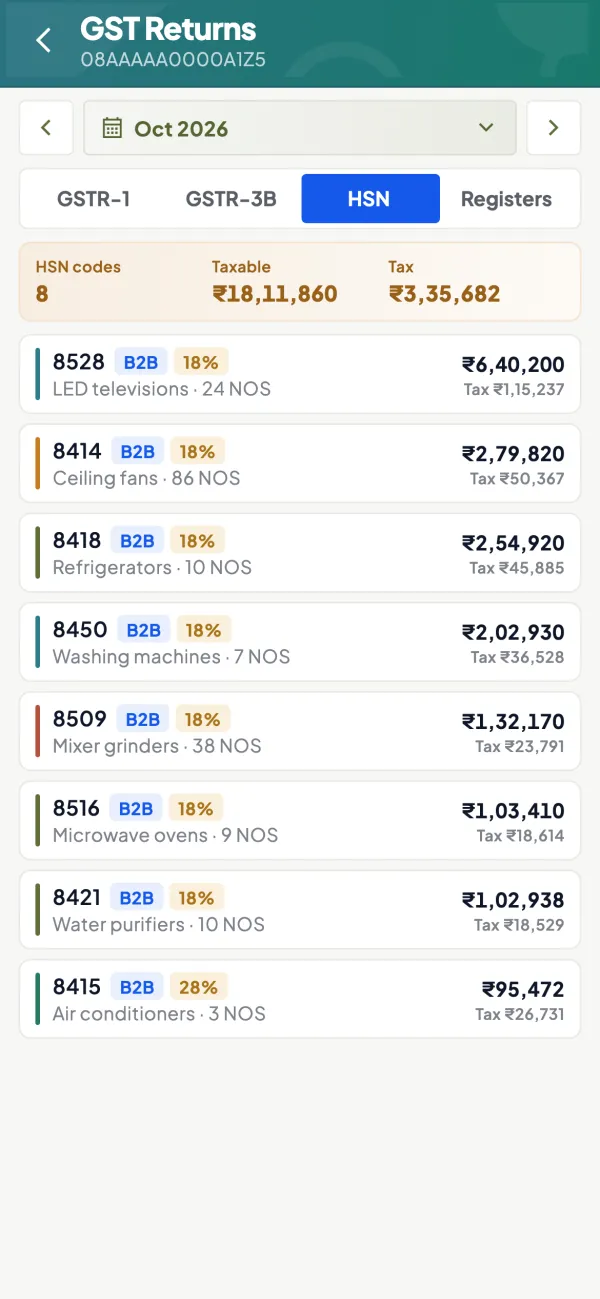
Cashflow OS prepares a GSTR-1 view from your synced Tally data. Its tiles open bill-wise detail, which is the quickest way to spot a B2B bill without GSTIN or a sale with the wrong tax type, and the HSN-wise view shows whether item codes and rates look right. Corrections are made in TallyPrime and appear on the next sync. The JSON can then be downloaded for the portal, where the return is filed.
Avoid these
Common mistakes
- MistakeTyping the buyer GSTIN on each billDo this instead
Verify the GSTIN once when creating the party and pick parties from the master, so every bill carries the right number.
- MistakeCharging CGST and SGST on an inter-state saleDo this instead
Set the party's state and delivery address correctly; if wrong, pay IGST and claim refund of the CGST and SGST.
- MistakeTyping HSN codes on each invoiceDo this instead
Keep HSN codes and GST units in item masters so the HSN summary matches the invoice tables.
- MistakeFixing the return but not the masterDo this instead
For every error, find which invoice and which master caused it, and correct the master so it does not repeat.
Keep handy
Checklist
Common GSTR-1 errors and how to avoid them — 8 checks. Tick them as you go.
In Cashflow OS
How Cashflow OS helps
Cashflow OS puts your TallyPrime books on every phone in the team. Where it fits this topic:
Bill-wise GSTR-1 tiles
The GSTR-1 view from your synced Tally data opens bill-wise detail, so a B2B bill without GSTIN or a wrong tax type stands out. Correct it in TallyPrime.
See GST reports from your Tally data
HSN-wise check
The HSN-wise view shows whether item codes and rates look right before you download the JSON for the portal.
Questions people ask
What happens if I enter the wrong GSTIN in GSTR-1?
What is the B2C large limit?
Can I correct CGST/SGST charged on an inter-state sale?
Why does the portal reject my HSN summary?
What is GSTR-1A?
Do nil-rated and exempt sales go in GSTR-1?
What is the last date to amend GSTR-1 for a year?
Can I report a missed invoice in a later month?
This page is general information for Indian businesses, not tax, legal or financial advice. Rules and rates change — check the official portals or your CA before acting.