GST GST invoices
Freight and delivery charges in GST invoices
Freight, packing and delivery you charge on your own sales invoice are part of the value of the goods. They are taxed at the same rate as the goods, not as a separate transport service.
- Wholesalers delivering goods
- Distributors with own vehicles
- Manufacturers charging freight
- Billing staff
- Accountants setting up Tally ledgers
On this page 12
The rule in one line
Section 15(2)(c) of the CGST Act includes in the value of supply incidental expenses such as commission and packing, and anything charged by the supplier to the recipient in respect of the supply at or before delivery. A seller who delivers goods and bills for freight is making one composite supply: the goods are the principal supply, and delivery goes with them. So freight takes the goods' rate.
Worked example: one rate
A Jaipur hardware wholesaler sells sanitaryware worth ₹50,000 (GST 18%) to a registered buyer in Jaipur, delivered in its own tempo, and charges ₹2,000 for delivery and ₹500 for packing.
| Line | Amount |
|---|---|
| Goods | ₹50,000 |
| Packing | ₹500 |
| Freight / delivery | ₹2,000 |
| Taxable value | ₹52,500 |
| CGST 9% + SGST 9% | ₹4,725 + ₹4,725 |
| Invoice total | ₹61,950 |
Showing freight as a separate line is fine and often clearer, as long as it is inside the taxable value.
Goods at different rates on one invoice
If one invoice carries goods at 5% and 18%, the freight has to be taxed in a way that follows the goods. The common, defensible approach is to spread the freight across the lines in proportion to their value.
Example. Goods A ₹30,000 at 5%, goods B ₹70,000 at 18%, freight ₹1,000.
- Freight on A: ₹300, taxed at 5% = ₹15
- Freight on B: ₹700, taxed at 18% = ₹126
Some businesses tax the whole freight at the highest rate on the invoice. That over-collects but is safer than taxing it at the lowest rate. Decide one method and apply it consistently. This is general information, not tax advice.
When freight is not part of your sale
- Ex-works sales where the buyer hires the transporter: the freight is between the buyer and the transporter. If the transporter is a GTA, the GTA rules apply to them; see GST on goods transport.
- Pure agent reimbursements: Rule 33 allows certain costs incurred as a pure agent of the buyer to stay outside your value, but only under strict conditions (a contract making you the buyer's agent, the buyer being liable to pay the third party, and separate showing on the invoice). Ordinary freight on your own sale rarely meets them.
- Freight recovered later by debit note: if it relates to the supply, it is still part of the value; the debit note should carry GST.
Other charges that follow the same logic
| Charge on your invoice | Part of taxable value? |
|---|---|
| Packing, forwarding | Yes |
| Loading and unloading at delivery | Yes |
| Transit insurance arranged by you | Yes |
| Installation, if part of the same supply | Usually yes, as a composite supply |
| Interest or late fee for delayed payment | Yes, under Section 15(2)(d) |
Discounts work in the other direction; see GST on discounts and schemes.
Free delivery and the freight you pay
If you offer free delivery, there is no freight line: the cost is built into your price and GST is charged on that price. The freight you pay to get goods to customers is your business expense. Where you hire a GTA, you may owe GST under reverse charge on it and can usually claim that tax back as ITC; where you hire a truck owner directly without a consignment note, there is generally no GST. Either way, what you pay the transporter and what you charge the buyer are two separate things. Do not net them off on the invoice.
Common mistakes
- Adding freight below the tax line, so GST is charged only on the goods.
- Charging 18% on freight when the goods are at 5%, because 'freight is a service'.
- Leaving freight out of the e-way bill value.
- Booking freight income in a ledger with no GST setting, so it never reaches GSTR-1.
Setting it up in Tally and checking in Cashflow OS
In TallyPrime, a freight or packing ledger used in sales vouchers can be set to be included in the assessable value for GST and apportioned to the goods, so tax follows the item rates. Once it is set, Cashflow OS shows those invoices in the GSTR-1 view prepared from your Tally data, and the HSN-wise detail lets you check that freight has been absorbed into the item values rather than left untaxed. If writing back is switched on, sales vouchers created from the phone are validated by Tally.
Avoid these
Common mistakes
- MistakeAdding freight below the tax lineDo this instead
Include freight and packing in the taxable value so GST is charged on them along with the goods.
- MistakeCharging 18% on freight with goods at 5%Do this instead
Freight on your own sale follows the goods' rate. Apportion it across lines when rates differ.
- MistakeLeaving freight out of the e-way bill valueDo this instead
Use the same values on the e-way bill as on the invoice, including freight that is part of taxable value.
- MistakeFreight ledger with no GST settingDo this instead
Set the freight ledger to be included in assessable value so it reaches GSTR-1 with the right tax.
Keep handy
Checklist
Freight and delivery charges in GST invoices — 7 checks. Tick them as you go.
In Cashflow OS
How Cashflow OS helps
Cashflow OS puts your TallyPrime books on every phone in the team. Where it fits this topic:
Check freight in HSN-wise GSTR-1
The GSTR-1 view prepared from Tally has HSN-wise detail, so you can check that freight was absorbed into item values rather than left untaxed.
See GST reports from your Tally data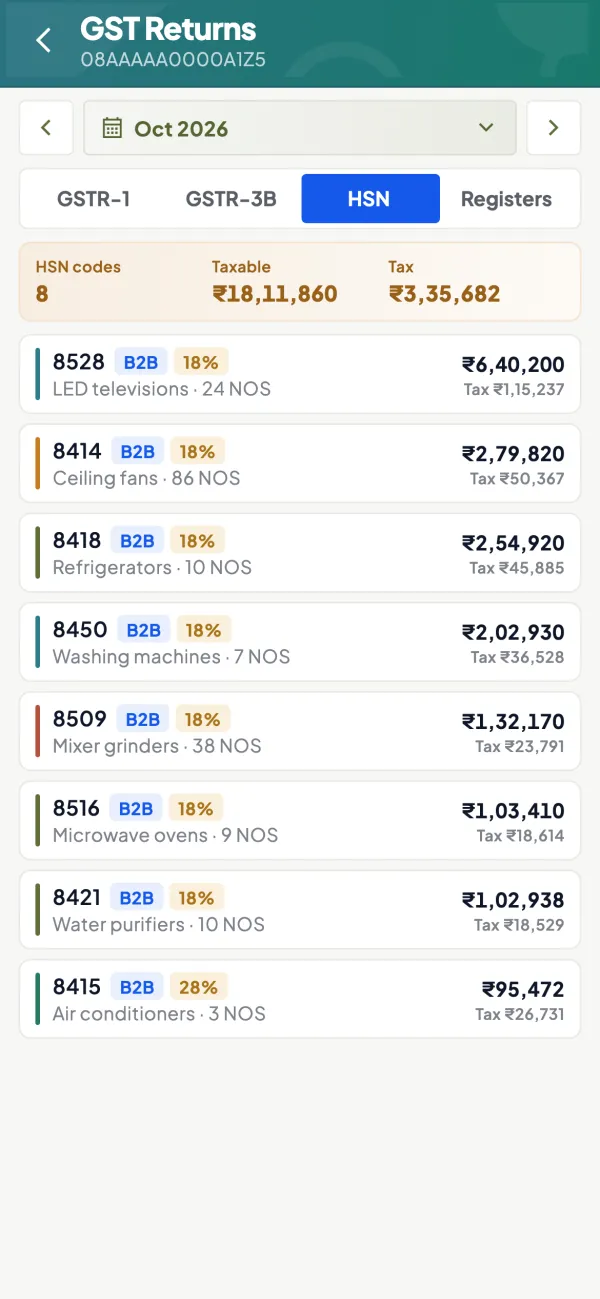
Sales vouchers checked by Tally
When writing back is switched on, sales vouchers created from the phone are validated by Tally, and GST is worked out from the item and the party's state.
See Create Tally vouchers from your phone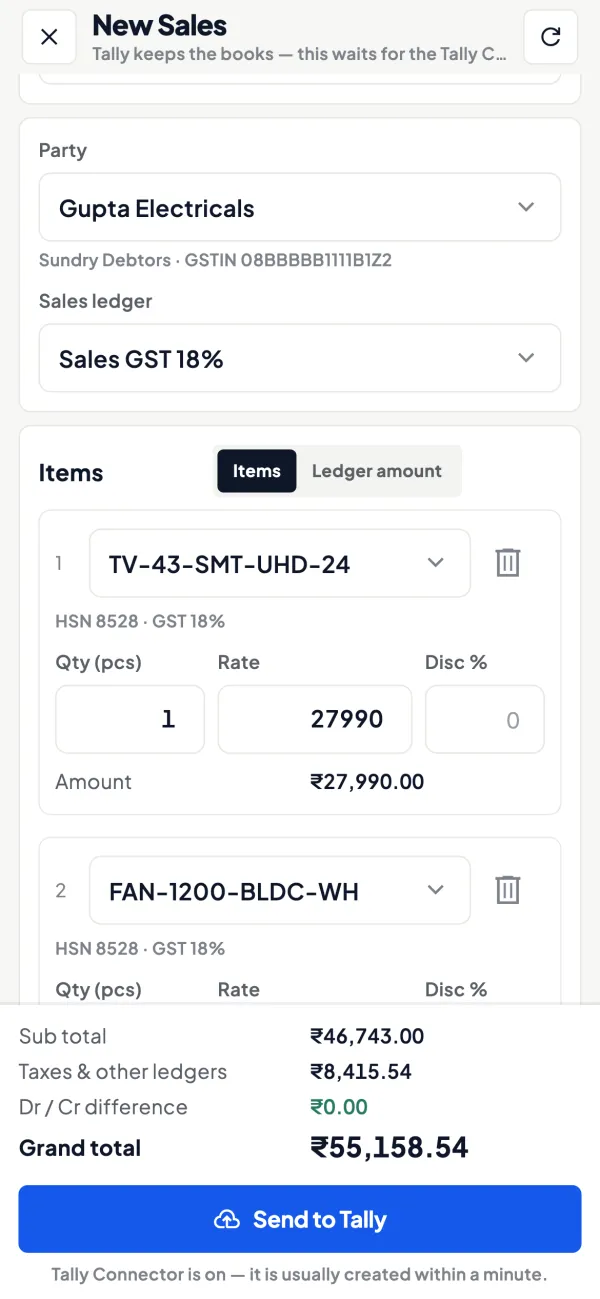
Questions people ask
What GST rate applies to freight charged in a sales invoice?
Should freight be shown separately on a GST invoice?
Is freight included in the e-way bill value?
Is my own-vehicle delivery a GTA service?
Is free delivery taxed separately?
Do I pay GST on freight I pay to a GTA?
Is packing taxed at the goods' rate as well?
What about late payment interest charged to a buyer?
This page is general information for Indian businesses, not tax, legal or financial advice. Rules and rates change — check the official portals or your CA before acting.